This excerp was taken from the book "Code Complete" by Steve McConnel, which was quoted as well in this blogs. Quoted:
(a) Industry Average: "about 15 - 50 errors per 1000 lines of delivered
code." He further says this is usually representative of code that has some
level of structured programming behind it, but probably includes a mix of coding
techniques.
(b) Microsoft Applications: "about 10 - 20 defects per 1000 lines of code
during in-house testing, and 0.5 defect per KLOC (KLOC IS CALLED AS 1000 lines
of code) in released product (Moore 1992)." He attributes this to a combination
of code-reading techniques and independent testing (discussed further in another
chapter of his book).
(c) "Harlan Mills pioneered 'cleanroom development', a technique that has
been able to achieve rates as low as 3 defects per 1000 lines of code during
in-house testing and 0.1 defect per 1000 lines of code in released product (Cobb
and Mills 1990). A few projects - for example, the space-shuttle software - have
achieved a level of 0 defects in 500,000 lines of code using a system of format
development methods, peer reviews, and statistical testing."
Friday, December 2, 2011


Monday, August 23, 2010
Stat 1: Internet Users in Indonesia Statistics - 2010

This is the first of statistic data series which is related to Information Tech and Communication.
The data can be used as a reference when you want to know the development of IT or Data Com in a specific country or region.
Monday, May 10, 2010
Business Process Management (BPM) Part 1
It becomes every company's objectives that it can do its operation to meet business objectives with more agility. In order to achieve that a company has to manage the interaction between human and application that support the business so that it drives business results and create value. A redundant, overlap and island of applications often create difficulties to meet this target. This is where Business Process Management (BPM) discipline can fit, as it refers to activities to optimise the business process in a company by automate manual process based on rules. BPM coordinates interactions between systems, business process and human interaction. Having BPM in place, then tasks can be routing to employees taking away non-value adding activities such as routines decisions, extracting data, filling up the forms.
To support a company in managing various aspects of BPM, Information Technology vendors develop an application suite. The application provide tools so that a business process can be visually design and model, simulate and test business process, automate and control the process as well as provide monitoring and reporting. This apps commonly understand as Business Process Management Systems.
One important key aspect is that the system must be able to talk to external systems, so that is not a stand alone system. Industry has come up with a standard technology which is called Web Services. A common framework of how this technology is deployed is called Service Oriented Architecture.
Saturday, April 10, 2010
Banking & Telco : Co-opetition
Porter Competitive Model is used to undertand and evaluate the structure of an industry 's business environment and the threats of competition to a specific company. The competition in an industry is based on five forces, e.g Intraindustry Rivalry, The bargaining of Buyers, The bargaining of suppliers, The treat of new entrants and the Threat of Substitute Products or Services.
Banking and Telco are actually two different industries, so evaluating Banking Industry using Porter Competitive Model I hardly think of Telco able to be as the treat of new entrants and providing a substitue products or services. However, telco companies have entered Banking Teritory and provide alternative products in the area of digital money or sometimes it is called eletronic money (e-money). This e-money mostly is used for micropayment.
In the 90's, banks in US has tried this with products such as MondEx, VisaCash, GeldKarte, however now telco also can provide similar functions. In Indonesia, telco provider such as Indosat has launched mobile commerce as well as Telkomsel with its T-cash. Banks like BCA also promote its e-purse which is called BCA Flazz, with similar purpose other businesses such as cinema and gas station also developed their own e-money.
A data that was quoted from Warta Ekonomi, telling that e-Money that is launched by Telco has increased quickly. In 2008, there are less than 1 million card, by the end of 2009 there are 2.9 million cards. Average transaction amount in Desember 2009 is about USD 3 / transaction. Overall Telco company has a customer almost 100 million, meaning that it is a huge potential market.
Phillipine is a another sample of which e-Money is very much developed. Mobile Banking with the with the helped of telco has become a huge succes in Phillipine. The services is also very rich including remittance services. So, at this stage Telco and Banks can be coexistence in providing this e-money services to customers.
Monday, March 1, 2010
eBanking and Mobile Banking Covergence
Another type of mobile banking is to do online banking through mobile browser (thin client). This becomes popular as mobile handset resolution, screen size and connection speed have much improved in the last few years. Now it becomes feasible to do online banking through your mobile. The provision of browser mobile banking will take off quickly as it removes the troublesome of Rich Client installation.
The browser mobile banking actually is not more than the ebanking itself. Bank doesn't have to do anything to provide this service. The convergence of the two world of internet and mobile has come to a stage where it becomes very usefull.
The introduction of thin client is actually also has its own challenge. Customer experience of using ebanking in desktop is not optimal. eBanking is designed for a bigger screen size and resolution so customer has to scroll the screen in every way to do online banking in mobile. It is lucky that vendor such as Infosys understand this challenge. Infosys has a product call mConnect which is part of its mobile banking solution.
mConnect is an intelligent application which will render the screen according to mobile resolution and size. Having this capability, banks can provide eBanking services with much more better experience as the layout, font size, colour and picture resolution will be optimised to be read in mobile browser. This will help customer to navigate the screen easier and quick.
Having this solution, then mobile banking has never been easier and Banks can launch this service once they have ebanking services.
Monday, February 15, 2010
Mobile Banking Evolution 2
Rich Client is designed to provide a more secure solution which SMS Banking can't provide. It looks quite promising as this application is able to a better user experience by having a meaningful user interface and screen flow that is easy to understand.
Rich client or thick client or Midlet is called because it is basically a program that is installed in your mobile. It can be called a Midlet if this is a program that is developed for java environment and use in Java Enable Phone with MIDP (Mobile Information Device Provile), however rich client is a more universal terminology which basically now iPhone, Android phone comes with a different standard as well.
Rich client or thick client or Midlet is called because it is basically a program that is installed in your mobile. It can be called a Midlet if this is a program that is developed for java environment and use in Java Enable Phone with MIDP (Mobile Information Device Provile), however rich client is a more universal terminology which basically now iPhone, Android phone comes with a different standard as well.
Always there is a price if you want to be more secured, in this case Customers have to install the rich client in its handset. This is a new challenge to the bank as application installation in mobile is not as easy as it looks. Different mobile will install the application in different directory, and it looks there is no definite guideline. While SMS is a straight forward services which will be available once you activate the number, rich clients need data plan in your number. Customers must be aware of this data plan in order for them to access the services through GPRS connection.
This creates various support issues either through the call centre and/or customer services at branch. Bank must assures that support for this cases. In recent years, application installation already can be given through OTA (Over the Air) mechanism and data plan installation is activated immediately during SIM card activation. These improvement will increase customer acceptance to use this Rich Client model for Mobile Banking.
Later we will discuss about the convergence of ebanking and mobile banking.
Thursday, January 14, 2010
Mobile Banking Evolution 1
Customers and Banks relationship has never been so closed. Banks create various innovative solutions to make sure customers are constantly in contact with banks. This becomes possible as mobile technology also becoming more advance then before. The use of mobile to provide banking services has started few years ago with what is known as SMS (Short Messages Service) Banking. The main advantages of SMS Banking are that it has high compatability with all cariers as well as handset type and transaction cost is cheap. However the perception of SMS Banking is not safe also arise due to its free text sending through the handset itself. This also then limit SMS Banking transactions to smaller amounts including introducing what is known as One Time Password (OTP) as a mean to protect any financial transaction. SMS Banking system will require a random password that valid only once and known only by the customer.
Another challenge for SMS Banking is for some people, to type SMS in order to do banking is not always convenient as it looks. This SMS Banking then also evolves becoming MENU Based - SMS Banking through SIM Application Toolkit (STK). Through STK, banks can create value added services in the SIM itself for Banking Transaction, however the technology that is used to send message is SMS.
This approach mandates Banks to build partnership with telco carrier so that the menu is installed in every sim card. Customers who has been used a carrier that has not had a partnership with the bank then can't do much except has to use to type the sms format as required to do banking transactions.
Having the limitation of SMS Banking, IT vendors and bank come up with different approach to help customers able to do banking easier by building a rich client or thick client. This will be discussed in the next article : Mobile Banking Evolution 2
Wednesday, December 23, 2009
Banking Innovations Forum 2009 - Bartłomiej Kozakowski, Comarch
This presentation provide a good discussion on how banking should innovate on the changes of customer doing banking which due to its different lifestyle and demands. The new technology enable bank to provide various channel to serve the customers and Web 2.0 technology will create a new way of banking service its customers
Tuesday, December 8, 2009
Business Modell Banking 2015 John White Ibm
John White brings a discussion on how banking industry will reshape and make the bank to think again their strategies. Business model innovation is key to growth and differentiation
Business Modell Banking 2015 John White Ibm
View more presentations from Fred Zimny.
Tuesday, November 17, 2009
Retail Bank's Cost Breakdown
This information is taken from Study that is done by IBM and the study is based on Bank's in Europe. However I think the information is still quite valid as customer facing activities require a lot of time which then logically contribute the higher cost percentage as well.

This information is quoted as I think many of us are looking for such information, and this sharing / discussion can be usefull.
Monday, November 16, 2009
Business Value - Performance Metrics (2)
If Delloite defines various aspects of Shareholders value that can be increased, however to measure it we also need its metrics. Gartnerin this Research provides what they call as The Gartner Business Value Model. This model helps a business to align Business Metrics with business aspects. The Business Value Model provides metrics that we use for several dimension. While this discussion doesn't compare in detail each value in Delloite's table with each metrics however we can see a coorelation between the two models, which always link to business.


Quoted from Gartner - The Gartner Business Value Model
Gartner defines three business aspects i.e.
- Demand Management - which consist of Market and Sales Responsiveness, Product Development Effectiveness, which much related to revenue growth and operating margin
- Supply Management - which consist of customer and supplier effectiveness, and operational effiency
- Support Management - this aspect consist of Human Resources, IT and Finance & Regulatory Reponsiveness.
So using these two maps - we are much help to be more structure to understand how the business is measured and how actually each of them able give value to shareholders.
Business Value - Performance Metrics (1)
Shareholders expects returns to its business investments. The challenge is how do you define the returns terms. What are the ascpect that we can use to explain returns that businesses have created to shareholders. This is also related to how do you can generate performance metrics to provide a clear explanation about business operation result that supposed to create the returns.
To discuss this topic, two major consulting firm approach are quoted in this edition. Deloitte provide as what is called as Enterprise Value Map. This Value Map defines shareholders value into four VALUE DRIVERS cateories i.e. Revenue Growth, Operating Margin, Asset Efficiency and Expectations. This model then drill-down each value into a more detail to support the value drivers into these steps :
- Level 1 : It show areas that you can do to improve each value.
- Level 2 : It triggers us to change what we have done - which looking at what we have provide, whom is the target, how do we compete, how we do our operations.
- Level 3 : It asks you to do better in each aspect by reviewing our business processes, aligning resources with strategies, improving control/reduce risk, collaborating more effectively
This model also have another dimension about where the improvement must be done in order to achieve higher business value. There are six key business process dimension in this model i.e :
- Business Strategy and Management
- Customer Strategy, Relationships and Interactions
- Product Strategy, Development and Production
- Human Capital Strategy and Management
- IT Strategy and Management
- Other shared services
By navigating the enterprise value map by Delloite, then we can also map how we want to go about for Shareholders Value Improvement.
Wednesday, November 11, 2009
Banking Solution - Architecture
There are many areas in Banking Operation that can be improved by using the right InformationSystem Solution. Actually automation in Banking requires a very comprehensive set of solution comparing to other industries. Transactional and non transactional system in banking need support from Information System.
Having this situation, one can be much helped if he can understand the solution components that are actually can be intergrated in a bank. Several Banking Enterprise Solution providers have provided their solution architecture for us so that we are able to see in high level how each solution is interlink one and anothers. In this discussion I quoted solution architecture that is provided by SAP, Infosys, Temenos and Oracle-iflex for our reference.
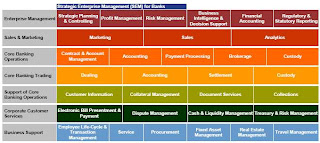
Diagram 1 : SAP - Solution Map
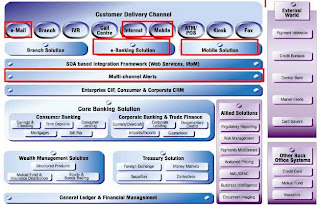
Diagram 2 : Infosys Solution Architecture
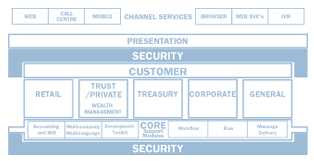
Diagram 3 : Temenos Solution Architecture
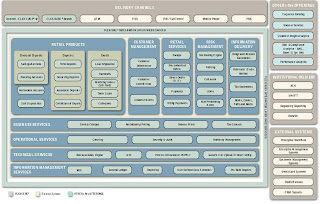
Diagram 4 : Iflex Solution Architecture
As can be seen, that in each solution architecture - we can see that there are three major sections for the banking operation automation i.e :
- Delivery Channel
- Customer Management
- Product Management
- Financial Accounting
- Decision Support System
In each section, an IT Managers then can map their current solution and see opportunities for automation improvement to support the overall business goal.
Monday, November 9, 2009
Getting Right User Requirements
Getting the right user requirements in initial phase of software implementation is always a challenge. Poor requirements specifications can result in systems that do not meet user needs. In the most extreme case, incomplete or error-riddled requirements specifications result in both time and money wasted building the wrong system. Customer perception of past solution package, past software problems and past operation procedure often build a wrong way of providing the right business requirements. Other aspect in getting the right business requirement is also due to schedule pressure which cause oversight.
Some ways to having a better process are :
- Including Business Process Owners who runs day to day operation in the discussion
- Having a software business analyst to interview business process owners
- Understanding that business requirements might not be able capture 100% since day one, so several can be categorised as current business, new business req and potentially new requirements that are not foreseen
- Mapping requirements into software standard package features, package extentions, and non system solution such as adjustment in the system procedures
- Choosing from several System Development Life Cycle approaches which is fit for a complex implementation such as : Spiral Model, Incremental Development are found will reduce risk.
To support the above process, especially getting complete business requirements - a tool from ravenflow which help to give a visual requirement definition can be also useful to validate if you have missing requirements.
Thursday, October 29, 2009
Business Intelligence - Implementation Challenge
Gartner has done a study about Top Strategic Technology in every year, and for the 2009 and 2010, Business Intelligence has become one of that list. If you want to know, whether you have used this technology in your work or company then this discussion would be answered your question.
Business Intelligence is a generic name which in its implementation and use can be in many forms. Wikipedia defined it as to skills, technologies, applications and practices used to help a business acquire a better understanding of its commercial context. It is aimed to help business decision making process more accurate as it has some valid data to support it.
While everyone would like be able to do so, however it its real implementation that is not easy case. Several key challenges that I experienced are :
- The project is treated as technology implementation. The project must have a strong business analyst or data analyst that knows exactly the requirements
- Users have not been discipline from the start in providing the necessary data to make decision. In this case the application will not be able to do anything
- Scope is not defined well and application comes as a tool. This often create a situation where the output is not what the users are expected
- Technology issues such as sizing capacity and the selection of the tools are also need to be prepared carefully
In this discussion - you might want to know what is there in the market for you to used, and Gartner clasification of Business Intelligence Platform could be usefull.
IT Strategic Grid
There are several methods on how you can evaluate where does and IT give the company value added. One of the methods is Strategic Grid Analysis which is developed by McFarlan and McKenney. This method is explained in 'Corporate Information Systems Management : The Issues Facing Senior Executives' (1983).
The strategic grid is useful explains where and how IT investmet has been made. It clasifies IT investment into four categories :
- Strategic : Investment that is critical for future success
- Turnaround : Investment that is strategic importance and be able to provide strategic opportunities
- Factory : Invesment that is required to sustain existing business. This investment aims to improve performance or reduce cost
- Support : Investment that is necessary for improving, but not critical to existing business. Normally this much related to individual performance improvement tools
The clasification helps management to see whether IT investments so far have been aligned to business objectives such as to support business growth, competitiveness or new business venture.
The IT Strategic Grid is normally drawed by 2X2 boxes which in each quadrant the four type of IT investment is listed. This link will give you an illustration of this tools as well as some additional definition.
Sunday, September 27, 2009
Software Quality Certification
Improving your software quality will require a lot of dicipline from your programmer in executing the SDLC method that you want to apply. I found many fresh programmers often look software source code management, change management, proper documentation as the burden. These topics also do not have to be a popular subject in the college or university. I discussed with couple of programmers with average about 1.5 years experience, many of them do not know the importance of it. While now a day, solution in software development and testing is already so advance which then will 'force' programmer must follow certain rules however providing the explanation of how importance of running those routines is the key.
In regards to equip programmers, system analysts and business analysts with a structured knowledge, it is worth to have your team member certified in these several subjects. The certification is approved by a body call QAI Global Institute. It has several certifications, several of them are :
- Certified Associate in Software Quality (CASQ)
- Certified Associate in Software Testing (CAST)
- Certified Associate Business Analyst (CABA)
- Certified Software Business Analyst (CSBA)
- Certified Software Process Engineer (CSPE)
- Certified Quantitative Software Process Engineer (CQSPE)
Most of the training is done through web and tested through prometric testing center wordwide. So it is quite flexible and also the cost of training also justify for you who want to have the right source of knowledge in improving software quality.
Saturday, August 15, 2009
Challenge IT Project in Small Medium Enterprise
What would be the challenge in implementing a project in Small Medium Enterprise (SME) ? Some critical success factors in implementing a project are User / Management Support, Project Scope, Infrastructure to support the project, Business/Process Understanding of the industry, Change Management, adequate resources and Personnel Leadership by Project Management. In a Small Medium Enteprise where many of these factors often can't be provided, implementing an IT Project can be a tough job. It is often that a system integrator wants to implement a project in SME environment has taken this factor too easy which then put the project into a difficult situation.
The challenge can comes in every factors which not because the SME does not want to support the project however it is merely the capacity is not there. In that situation, a system integrator must be able to calculate the risk and find a chance to educate the SME before the project is started. It is must be overlooked because the customer size is relatively small then the project could be easier. This could be trapped that a new project manager will face.
In that situation some key suggestion including :
- Strong Project Management Leadership on both side
- Drive by the higher management can help a lot
- Find an informal leader to be the advisor of the project
- Implementing a good change management approach is important
While it looks quite familiar in many project however in SME those aspect can be even critical, because those are only the basic - minimal requirements before a project can start.
Sunday, July 26, 2009
Tools for Project Management
Managing multiple project can be very not effective if you are not supported by the right tool. Focus and prioritation of a project manager must be on the project and must not on the tool, however without the right tool you are not possible to direct your projects into the right point.
There are a lot of tools in the market now, which is offered either by SAAS model and the normal installation model. However whatever tools that you are selected it must be able to do several key tasks i.e. Project Registration, Project Portfolio and prioritation, Resource Registration, Resource Time Sheet, Project Cost and Resource Tracking, Project Plan Development.
Several solution that you can choose in the SAAS model that worth to look at is Innotas, as well as @task This project management tools is very informative as well as it has moved also to application portfolio management which overall give a complete set of IT governance tools. While for the full blown Enterprise Project Management, the recent Microsoft Enterprise Project Management is a strong strong solution that you can evaluate. This tool has been much improved from its previous version and be able to compare with Primavera Solution who has been acquired by Oracle
If you prefer to look for more SAAS type of solution, this link would be able to help you. This site give a list for all SAAS solution that you can possibly have.
Subscribe to:
Posts (Atom)